Introduction of the London Festival of Architecture
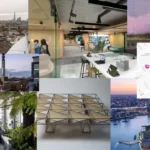
The London Festival of Architecture is one of those rare citywide events that feels both ambitious and easy to enjoy. It spreads across London for a full month, which means it does not trap visitors inside one venue or one district. Instead, it turns the city itself into the exhibition space, the route map, and the conversation. The official festival dates are 1–30 June 2026, and the central theme for the year is Belonging. The festival describes this edition as a platform for discussion, new ideas, emerging talent, and a more equitable, sustainable city.
That combination matters. This is not an event only for architects, planners, or design professionals. It is open, public, and highly navigable, with tours, talks, installations, exhibitions, workshops, performances, mentoring, open studios, launches, film screenings, and more. The official programme can be explored by activity type, neighbourhood, collection, and audience, which makes it ideal for readers who want a practical weekend guide rather than a dense calendar of listings.
If you are searching for a London Festival of Architecture weekend guide, London Festival of Architecture 2026, LFA 2026 Belonging, architecture events in London, free architecture events in London, London architecture tours, or London design talks, this guide is designed to help you plan your visit without stress. It focuses on the most useful questions readers usually have: what the theme means, which neighbourhoods are worth visiting, how to choose events, and how to shape a great London day around architecture, culture, and walking.
Quick Facts About the London Festival of Architecture 2026
| Topic | Details |
| Festival name | London Festival of Architecture 2026 |
| Dates | 1–30 June 2026 |
| Theme | Belonging |
| Format | Month-long, citywide architecture and city-making festival |
| Activity types | Talks, tours, exhibitions, installations, workshops, performances, mentoring, open studios, launches, film screenings, and more |
| Planning tool | Official programme filters by activity type, neighbourhood, collection, and audience |
| Main idea | Public, walkable, neighbourhood-led architecture festival |
Why the London Festival of Architecture 2026 Matters
The London Festival of Architecture has outgrown the label of a niche design event. It now operates as a public cultural platform that places architecture inside the life of the city. According to the festival’s official story, LFA has been championing design and London as a global architectural hub since 2004, with a strong emphasis on emerging talent and underrepresented voices. It is also positioned as an event for anyone interested in London’s architecture and built environment, not only those working in the industry.
That public-facing approach is one of the main reasons the festival works so well as a weekend story. You do not need to know every style, movement, or planning theory to have a good time. You can simply choose one neighbourhood, book one talk, join one tour, and stop by one installation. That is enough to feel the energy of the festival. The official website is designed to support exactly that kind of browsing, with clear filters and easy entry points for first-time visitors.
The wider cultural value of the festival is also important. It shifts architecture away from being something you only see from the outside and turns it into something lived, discussed, and debated. Streets, public squares, heritage, local identity, regeneration, community, and sustainability all become part of the same conversation. The festival’s mission is to make architectural thinking more accessible, to support experimentation, and to uncover or amplify new voices.
A Short History of the Festival
The festival began in 2004 under the name London Architecture Biennale. Its first edition lasted ten days and had a tightly local focus on Clerkenwell. According to the festival’s official history, the early concept was to show how the past informs the future and to make architecture more open to different audiences and communities.
That origin story explains a great deal about the festival’s identity today. It did not begin as a large trade event or a closed professional conference. It began as a public-facing urban festival grounded in access, discussion, and place. Over time, it expanded from a single neighbourhood into a citywide June programme with hubs, routes, local stories, and hundreds of activities. The evolution from a local pilot into a wider urban network is one of the reasons LFA feels so distinctive.
The history also reveals something useful for readers: movement has always been central to the event. Early editions included walks, talks, road closures, installations, and city trails. That same sense of movement still shapes the modern programme. The festival is not just a collection of rooms and lectures. It is a route through London, a sequence of experiences, and a way of seeing the city differently.
What the Belonging Theme Means in 2026
Belonging is a powerful theme because it operates on several levels at once. It can mean seeing yourself represented in the built environment. It can also refer to shaping a place rather than passively inhabiting it. The official festival materials state that the 2026 programme is built around belonging, while cultural partner coverage connects the theme to accessibility and a more Equitable, healthier, greener city.
The idea also fits wider public conversations around cities today. More people are asking who public space is for, how neighbourhoods evolve, how buildings can be reused, and how communities can feel included rather than excluded. LFA 2026 taps into that moment by looking not only at how places appear, but at how they function socially and emotionally. The theme is not abstract for abstraction’s sake. It is grounded, civic, and highly relevant.
The official neighbourhood pages give that theme real texture. Fitzrovia is presented as a place where culture, collaboration, and community intersect. South Bank and Waterloo are described through transformation, public life, and change. Chrisp Street connects to the Festival of Britain and East End identity. Thames Road is framed as a place where belonging is being designed in the present tense. Each of these places tells a different version of the same story.
The Best Way to Plan a London Festival of Architecture Weekend Guide
The easiest way to enjoy the festival is to keep your plan simple and spatially focused. Do not attempt to cover the entire city in one day. The programme is broad, and the whole point is that it can be tailored. Choose one area, one headline event, and one lighter complementary activity so that you have time to walk, look, pause, and absorb the atmosphere.
A good weekend rhythm might look like this:
| Part of the day | Best choice | Why it works |
| Morning | Walk or tour | Streets are quieter and easier to read |
| Midday | Installation or neighbourhood project | Good for flexible wandering |
| Afternoon | Talk, exhibition, or open studio | Let’s go deeper into one idea |
| Evening | Keynote, performance, or social event | Strong atmosphere and energy |
This is not official festival advice; it is simply the most comfortable way to experience a large citywide programme without feeling rushed. The official event structure makes this easy because the listings span many formats and locations.
A simple rule for first-time visitors
Pick one neighbourhood, one standout event, and one short walk. That is enough to create a satisfying day. Because the festival is organised around neighbourhoods and filters, narrowing your focus actually improves the experience rather than limiting it.
A smart rule for repeat visitors
Choose a different neighbourhood each day and compare them. This is one of the best ways to experience LFA. London changes character from area to area, and the neighbourhood-based structure encourages visitors to read the city as a cluster of local stories rather than one generic metropolis.
The Main Programme You Should Know
The official programme is already live and can be filtered by activity type, neighbourhood, collection, and audience. That is one of the strongest practical features of the festival because it lets visitors search for what they actually want instead of scrolling endlessly.
The available activity types include Free, Exhibition, Film Screening, Installation, Launch, Mentoring, Open Studio, Performance, Talk, Tour, Workshop, and Open 24 Hours. That range makes the event highly searchable and gives readers a lot of choice.
The audience filters also show how broad the festival is. The programme is not limited to industry professionals. It includes options such as Everyone, Families, Local Residents, Young People, Students, and People Over 55. That makes the festival useful for lifestyle readers, family planners, students, urban explorers, and culture tourists as well as architecture specialists.
The homepage also highlights a few curated examples that reveal the range of the 2026 edition. These include the Murray Lecture: Jayden Ali, Goulston Street Pocket Park: Macchiato, Millennium Mills: Exploring Retrofit Futures in the Royal Docks, and Sessions One-to-One Mentoring. Those examples are useful because they show the breadth of the programme: public lecture, local public space, retrofit debate, and support for emerging voices.
Best London Architecture Tours
If you are shaping a strong London architecture tours section, the best approach is to combine tours with a few public talks. That creates an article that feels experiential rather than just informational. The official neighbourhood pages offer several especially strong places to start.
South Bank and Waterloo
South Bank and Waterloo are two of the clearest anchor points for a weekend itinerary. It combines a famous riverside setting with an important architectural and cultural narrative. The official neighbourhood page says the area is entering a pivotal period of transformation and marks the 75th anniversary of the Festival of Britain in 2026. It also ties the district to public life, culture, and change.
That makes it a perfect first-time visitor zone. You can walk the river, enjoy major cultural landmarks, and still connect the day to the larger themes of the festival. The neighbourhood page also references important developments such as the Waterloo Station Masterplan and the Royal Street life sciences campus, which adds contemporary relevance to the area.
Fitzrovia
Fitzrovia is one of the most theme-aligned neighbourhoods for 2026 because the official page describes it as a place where culture, collaboration, and community come together. It also connects to Find Fitzrovia, a project with bold wayfinding interventions and guided discovery of hidden spaces. That makes the area especially appealing for people who enjoy urban detail, design-led wandering, and quieter city discoveries.
The official listing also includes a two-hour guided walk from Whitfield Gardens to Fitzroy Square. That is exactly the kind of event that suits a weekend guide: substantial enough to feel meaningful, but not so long that it takes over the whole day.
City of London
The City of London is an excellent choice because it combines extreme historical depth with contemporary architectural spectacle. The official neighbourhood page describes it as a place of constant evolution, where the built environment ranges from new towers and roof gardens to ruins more than 2,000 years old. That contrast alone makes it a compelling area for visitors.
The City also functions as an important hub in the festival’s wider geography. The London Centre appears as a central point on neighbourhood and city programme pages, and editorial previews describe it as a location for talks, performances, and interactive activity. For readers who want a central and easy-to-reach base, it is a strong option.
Chrisp Street
Chrisp Street is one of the most meaningful neighbourhoods in the 2026 programme because it ties directly to the Festival of Britain and East End identity. The official page explains that it is the UK’s first purpose-built pedestrian shopping centre and that it was rebuilt in 1951 for the Festival of Britain. That gives the area substantial heritage value.
The page also notes that today it remains a place of traders, street art, and strong local identity. In other words, it is not just historic; it is alive, communal, and everyday. That makes it an especially good place to discuss architecture through lived experience rather than pure aesthetics.
Thames Road
Thames Road is a particularly interesting choice if you want to include a future-facing story. The official neighbourhood page explains that the area is moving from an industrial corridor toward a mixed-use neighbourhood for South Barking, with new homes, public spaces, improved streets, and flexible workspaces planned. The festival frames it as a place where belonging is being actively designed.
That makes Thames Road a great fit for readers who prefer something less central and less obvious than the headline districts. It adds geographic range to your article and gives the festival a strong “city of tomorrow” dimension.
The 11 LFA 2026 Neighbourhoods You Should Mention
The official neighbourhood page lists 11 neighbourhoods at the heart of the 2026 festival. That is one of the most valuable facts to include in a pillar article because it demonstrates both scale and local focus.
The 11 neighbourhoods are: Chrisp Street, Canning Town and Leamouth, City of London, Colindale and Edgware, Fitzrovia, Royal Victoria, South Bank and Waterloo, South Kensington and High Street Kensington, Thames Road, Wandsworth Town and the Wandle Delta, and Wood Green and Alexandra Palace.
The festival presents these places as the core of the event. They are the spaces where local stories, people, buildings, and neighbourhood change become visible during June. They also help visitors uncover hidden details, revisit familiar districts, and engage with future plans for the city.
Best neighbourhoods
| Reader type | Best neighbourhood | Why |
| First-time visitor | South Bank and Waterloo | Easy to reach and rich in landmark context |
| Design lover | Fitzrovia | Strong tie to the theme and hidden urban detail |
| History fan | Chrisp Street | Festival of Britain story and East End heritage |
| Urban Futures Reader | Thames Road | Major change, mixed-use planning, new identity |
| Central London explorer | City of London | Powerful mix of old and new architecture |
How to Build a Flexible Weekend Plan
A good weekend in London should feel smooth, not rushed. The official programme already gives you the structure, so the goal is simply to use it well. Because events are dispersed across the city, it is smarter to plan by area rather than chase every popular listing.
A one-day plan
Start in Fitzrovia or the City of London. Attend one talk or open studio in the morning. Stop for lunch nearby. Then choose one installation or a short walk in the afternoon. Finish with coffee, a river stop, or a quiet evening event. That rhythm keeps the day balanced and minimises transit stress.
A two-day weekend plan
Use one day for South Bank and Waterloo. Use the second for Fitzrovia or Chrisp Street. That way, you experience both a highly recognisable central district and a more local, narrative-driven neighbourhood. It creates a stronger sense of contrast and makes the article feel richer.
A family-friendly plan
Use the programme filters to search for Families, Free events, Tours, and Workshops. Since the festival provides audience categories, family readers can quickly build a day that feels manageable and age-appropriate.
Are There Free Events?
Yes. According to the official NLA materials, most events are free to attend, and organising an event with LFA is also free. That is a very strong selling point for readers looking for free architecture events in London.
That said, it is still important to check each individual listing. Some partner events may be ticketed, and some may require advance booking or have limited spaces. The safest approach is to save the event, open the listing, and confirm the details before you travel.
Travel Tips for Visitors
London is easy to move around, but the size of the festival means that a little planning goes a long way. The neighbourhood structure makes it sensible to spend part of the day in one area rather than crossing the city repeatedly.
Useful travel habits for LFA 2026
Use Tube, bus, or rail connections to keep the day flexible.
Wear comfortable shoes because many of the best events are walkable.
Bring a light layer because the London weather can change quickly.
Check whether the event is free or ticketed before leaving.
Keep one part of the day open for wandering.
These are simple travel basics, but they work especially well for a festival built around streets, public spaces, and local exploration.
Best starting point
For many visitors, the easiest starting point is the London Centre in the City of London. It appears as a key hub in the festival materials, and preview coverage describes it as a place for talks, performances, and interactive displays. That makes it a smart anchor if you are unsure where to begin.
Best area for a scenic route
South Bank and Waterloo are the strongest scenic options because they combine riverside walking, major cultural landmarks, and a clear transformation story. The official page links the neighbourhood to public life, culture, and the legacy of the Festival of Britain.
Fashion and Lifestyle Angle
The festival is not a fashion event in the conventional sense, but it has a strong visual rhythm. The most practical outfit choice is also the most stylish one: comfortable layers, easy footwear, and a bag that works for a full day on foot.
A polished festival look might include tailored trousers, a light coat, a plain top, and trainers or flats that can handle walking. That is enough for a day of tours, talks, and café breaks. It also fits the urban mood of the event without making the article feel overly styled.
Food, Culture, and Things to Pair With the Festival
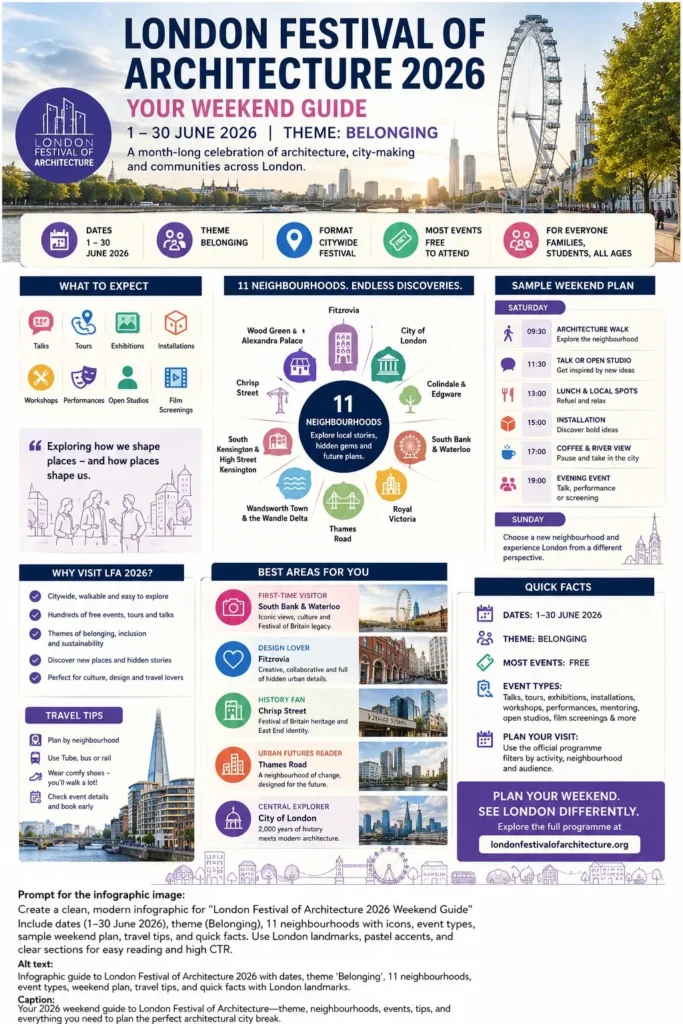
One of the reasons the festival works so well as a weekend guide is that it blends naturally with everyday city life. A morning talk can lead to lunch nearby. A tour can end with coffee. A riverside installation can become the prelude to dinner. That combination of culture and routine makes the event feel approachable.
The neighbourhood structure also helps with this. South Bank and Waterloo naturally lend themselves to riverside cafés and longer pauses. Fitzrovia works well for quieter lunch spots and a slower pace. The City suits short, efficient lunch breaks and tightly structured visits. Chrisp Street gives the day a more local, market-oriented feel. These are not official food recommendations, but they are useful ways to frame the experience.
Best food-and-culture pairing format
A strong festival day often follows this pattern:
breakfast → talk or tour → lunch → installation or exhibition → coffee stop → evening event
This structure is easy to follow, easy to write about, and easy for readers to imagine. It also helps the article feel like a real weekend plan rather than a listing dump.
Pros and Cons
Pros
The festival is citywide, flexible, and easy to tailor. It offers a strong mix of talks, tours, installations, workshops, and performances. A large share of the programme is free. It also has a clear central theme in Belonging, which makes the 2026 edition easy to explain, easy to search, and easy to connect to wider cultural conversations.
Cons
The scale of the programme can feel overwhelming if you do not start with a neighbourhood. Some events may be ticketed or fully booked. Travel time matters because the festival spans many different parts of London. Outdoor events can also be affected by the weather. These are normal urban-festival challenges, but they are worth noting.
Why This Festival Fits a Modern Weekend Guide
The best reason to cover the London Festival of Architecture 2026 as a weekend guide is that the event matches real search intent. People are not only looking for a definition. They want practical answers: how to visit, where to start, what to see, whether it is free, and how to make the most of a single weekend.
LFA answers those questions unusually well. It is annual, public, walkable, and clearly structured. The neighbourhood model lets readers build their own route through the city based on interest and location. The filters make the programme easy to adapt. That is exactly what makes it useful as a ranking article and as a reader-friendly editorial piece.
The festival also carries strong editorial value because it sits at the intersection of architecture, culture, travel, community, public space, sustainability, and urban change. That gives the article broad semantic depth without turning it into keyword stuffing. It also explains why the 2026 theme of Belonging matters beyond the design sector.
FAQs
The London Festival of Architecture is a month-long June festival of architecture and city-making across London. Its official mission is to open up discussions around architecture, test new ideas, and support emerging talent.
LFA 2026 runs from 1–30 June 2026.
The 2026 theme is Belonging. The official festival page says all 2026 activity will focus on that theme.
A large share of the programme is free. The official NLA page says most events are free to attend, though some partner events may still be ticketed.
The easiest first stop is the London Centre in the City of London, or a simple route through South Bank and Waterloo. Both are useful starting points because they give visitors a clear sense of the festival’s scale and character.
Conclusion
If you are planning a June city break or a Culture-Led weekend in London, the London Festival of Architecture 2026 is an easy event to build around. The London Festival of Architecture 2026 is more than a design event. It is a month-long celebration of London’s neighbourhoods, public spaces, creativity, and community life. With the 2026 theme of Belonging, the festival encourages visitors to explore how architecture shapes everyday experiences across the city. From riverside walks in South Bank and Waterloo to hidden streets in Fitzrovia and heritage stories in Chrisp Street, LFA offers something for culture lovers, families, students, and travellers alike. Whether you attend one talk or spend an entire weekend exploring, the festival makes London feel open, walkable, inspiring, and deeply connected to the people who live there.